Showing posts with label Auto Racing. Show all posts

Friday, September 17, 2010

F1 Mid-2010-Season Primer

Formula 1
For someone in the unlikely situation of being new to watching motorsports but having access to the Speed Channel, Formula 1 is an appealing starting point. The cars are fast and exotic, the competition is close, the tracks are in interesting places all over the world, and the coverage is extensive, informative, and entertaining. Regardless, it may still be difficult to have an immediate grasp on everything that is going on, particularly mid-season. The Formula 1 website is a fantastic source for detailed information (particularly about the rules and various technical aspects of the sport). There are a few unique, and important, characteristics of Formula 1 that will come up during a regular broadcast, such as:

Team structure - This season there are 12 teams (or "constructors"), and each team is comprised of two drivers. The teams are called constructors because they do in fact design and build their own cars (but not the engines). There are no "customer cars" allowed this season, so one team cannot buy cars or parts (with the exception of the engine) from other teams. The engines are tightly regulated this season, and only a handful of engine manufacturers are available for use by the constructors: Cosworth, Ferrari, Mercedes, and Renault. Both the constructor's and engine manufacturer's names are usually used to identify the teams, such as "Red Bull Renault" or "McLaren Mercedes."

The two championships in contention -  Each driver is racing against all of the other drivers in an effort to finish in the best position possible. For each race, the winning driver gets 25 points, 2nd place gets 18 points, etc. down to 10th place which gets 1 point. Cars finishing behind 10th get no points (complete details here). Additionally, each team is awarded the sum of the points scored by their two drivers. At the end of the 19-race season, the driver with the most points is crowed Drivers' World Champion, and the team with the most points is crowned Constructors' World Champion. Both championships are thought to hold equal weight and importance.

Qualifying format - The starting order for each race is determined by a three-stage qualifying system. All 24 cars have 20 minutes to set the fastest lap possible. The cars may qualify at any point during the 20 minutes, and the cars do not necessarily get the track to themselves. Following the first session (called "Q1"), the six slowest cars are set at the six worst starting positions. After a short break, the remaining 18 cars then have 15 minutes to again set the fastest lap possible. The times from Q1 are disregarded and these 18 cars must re-qualify. Following the second session ("Q2"), the eight slowest cars are set at the next-eight-worst starting positions. After a short break, the remaining 10 cars then have a final 10 minute session ("Q3") to again re-set their fastest lap to determine the top 10 starting positions.

Team orders - There are a number of circumstances during which a team would find it advantageous to have their drivers finish in a particular order. By mid-season it can become clear to a team that one of their drivers has a better chance to win the Drivers' World Championship than the other, and the team may want to provide that driver with the best chance for success, for example. The sporting regulations state that teams are not allowed to orchestrate in any way the finishing position of their two drivers relative to each other, but there have been many instances where this has almost certainly been the case. One case was during the Hungarian Grand Prix, Ferrari's Felipe Massa was told over the radio that his fellow Ferrari driver, Fernando Alonso, was "faster," and Felipe was asked "do you understand that message?" Shortly thereafter, Massa's Ferrari slowed significantly coming out of a corner, allowing Alonso to dart by. Massa had no further trouble during the race.

F-Ducts - The McLaren Mercedes team developed a system to direct air from the front of the car through a duct in the dorsal section to the rear wing. When this duct is activated (by the driver's hand or knee), the airflow stalls the rear wing, drastically reducing both its downforce and drag, causing a large increase in top speed down the straights at no downforce penalty in the corners. Other teams are just starting to develop their own versions of this system, but the cars are so aerodynamically sensitive that any change requires extensive research and development to be effective.

Corner names - Most Formula 1 tracks have names for each of their corners. Many corners are named after notable racing drivers, but some are named more arbitrarily. Turns 6 and 7 of Monza, the track used for the Italian Grand Prix, are called the "Lesmos," which can cause some confusion during the broadcast.

There are also a few things to note about the broadcast and coverage itself:

The cameras are not controlled by the commentators - Where the cameras are placed along any given track and on any given car, as well as which camera shot is used at any given point, is controlled by FOM, the singular Formula 1 rights manager. The Speed Channel commentators are therefore forced to call the race as it is presented to them. Normally this is seamless, although on occasion the commentators are interested in a particular pass or battle that is not shown for as long as they would like. Overall the camera work is excellent, and the commentators are able to provide a constant stream of information relating to the standings, the current strategies, the various pieces of technology on the cars, layman's translations of radio broadcasts, etc. One downside to the extent of the coverage and commentary is that missing something said by one of the commentators is undoubtedly missing something important, interesting, and entertaining. Socializing during the broadcast is not watching the race.

The three main commentators are off-site - Bob Varsha, Steve Matchett, and David Hobbs call each race from a studio in North Carolina, in real-time. Will Buxton is on-site at each race, although he gets significantly less air time than the other three. Will Buxton is new to the broadcast team for this season, and he is a replacement for Peter Windsor who had been a close friend of the other commentators. Buxton has useful access to drivers in-person although he frequently injects his opinions into his reports, and those opinions are not always objective or even factually accurate.

The pre-race show and post-race interviews are must-watch events - For 30 minutes before the race, the commentators will discuss in great detail various technologies and strategies employed by the teams, review important storylines, and show relevant highlights from earlier in the weekend (practice and qualifying) or the season. The show is dense with information while being entertaining and exciting. Following the race, there is extensive discussion about the repercussions of the results on the two championships, and the official driver interviews provide fascinating insight into how each of the top three finishers saw the race.

While the above is by no means comprehensive, with any luck a new viewer will have an idea of the volume of entertainment and information they will experience watching a Formula 1 Grand Prix.

Enjoy!

Thursday, March 25, 2010

Let's Get Physical


I am occasionally scoffed at when I suggest that race drivers need to be in good physical shape. Most people can at least believe that pro drivers are in good condition, but not that it’s explicitly necessary for them to do what they do. I have struggled in the past to convey how, exactly, driving is in fact physical. I’m going to give it another shot here. Part of the difficulty is that race driving (like most sports) is a pretty unique activity; it’s not much like anything you’re likely to have done before, and driving a race car is extremely different from driving a “regular” car.

So, let’s play an imagination game:

For round one of our game, imagine trying to open a combination lock; a round one with a dial like you would find on a gym locker. Let’s even assume you know the combination. Certainly it isn’t physically challenging, although it does take some precision and you need to be able to see what you’re doing. Easy.

For round two, imagine the lock isn’t on a locker, but it’s chained to a 45lb plate like you would use to lift weights at the gym. Let’s make it interesting by saying you have to wear this contraption as a necklace like Flavor Flav turned into a gym rat, and you have to remain standing. Now that you’re trying to support the weight while you’re working the lock, it becomes more physically challenging. Turning the dial just right is harder when you’re also exerting yourself, but as long as you can hold up 45lbs or so for a minute you should be ok, right?

Now let’s make it really interesting. The good news is for round three you’re sitting down, the bad news is you’re sitting on a roller coaster; think of the most intense roller coaster you have actually been on, only very slightly modified to allow you to reach the lock-chain-weight combo that’s now in your lap (although still around your neck). Imagine trying to unlock the lock while the roller coaster is going. Now we’re talking about a real challenge: keeping the thing in your lap at all is pretty tough, but trying to spin that little dial to just the right numbers (without smacking yourself in the face with the weight) you can imagine is hard. Your head is being jostled around, the lock itself is all over the place, and that weight gets pretty unwieldy in that corkscrew section. I’m willing to bet, though, that if you could keep the thing in your hands you could unlock the lock once (or a few times) without really getting tired. Tough? Sure. Tiring? Probably not.

Round four. Something has malfunctioned on the roller coaster. This isn’t the usual car-gets-stuck-upside-down malfunction though; this is the ride-doesn’t-stop-at-the-end-and-just-keeps-going malfunction. You’re not in much danger (as long as you don’t hurt yourself with that weight), but you’re not getting off any time soon. Say the thing goes for an hour; some “ride engineers” are there, the Channel 4 helicopter is circling, but you’re stuck on the darn thing. Worry about keeping your lunch down later; how is it coming with that lock? Imagine if you got more points every time you unlocked, then re-locked the lock. How many times could you do it? How long could you hold the thing in your lap while your roller coaster just kept going? A few times, probably, but you can imagine how it gets pretty difficult pretty quickly.

Race drivers don’t need to unlock combination locks chained to weights, and they’re not on roller coasters. They are, however, being thrown around in their seats while trying with their hands and feet to do things that simultaneously require both strength and precision, sometimes for hours at a time. If you have never done it before it’s tough to imagine that turning the wheel and pressing the pedals could be tough; the car you drive to work has power steering and power brakes, and most of the time it doesn’t really matter how much you turn or press them as long as you’re close. Race cars (and fast go-karts) require strength to turn the wheel and press the pedals; hard to believe but it’s actually physically difficult. To go fast, you have to do those things exactly the right amount at exactly the right time. It’s difficult and challenging in the same way that round four of our imaginary game is difficult and challenging.

I highly recommend that anyone who is curious about it to go to a decent go-kart track and give it a shot. Don’t bother with the slow stuff, head to a place that requires helmets and neck braces, like F1 Boston. It’s a ton of fun, and I promise you’ll learn something.

Wednesday, March 03, 2010

US F1: Just The Facts, Ma'am

Ken Anderson has spoken to Autosport about the current status of the US F1 team.

Mr. Anderson confirmed that the team will not participate in the 2010 season, and has requested that the FIA defer their entry until 2011. The team is intact, with the exception of previously-contracted driver Jose Maria Lopez and some temporary staff members, and is optimistic that the FIA will quickly grant their request. A sponsorship deal fell through in mid-January and without it the team was simply unable to commit to racing, however most of the preparations to do so were in place. The interview is worth reading as it clears up much of the blather that has been careening around this week.

Tuesday, March 02, 2010

US F1: Good News and Bad News

Following a day of rampant speculation, there is good news and bad news about the fledgling US F1 team.

First, a little background:
Formula 1 isn't open to all comers. There are a limited number of available spots on the grid, set by the sport's governing body, the FIA. Even a fully-funded, ready-to-run team can't simply show up and race. Several teams from 2009 withdrew from the sport and the FIA further expanded the total number of available spots, making room for four all-new teams. Out of the many prospective teams that applied for those spots, the US F1 team was one of those selected to join Formula 1. The FIA's decision was intended to strengthen the sport both by including a US-based team, but also by filling the grid with teams that displayed both possible competitiveness and longevity.

The bad news, summarized effectively by AutoSport, is the US F1 team will almost certainly not be ready for the season-opening race at Bahrain. The team has formally asked the FIA to defer their entry until 2011. This unprecedented move has a measure of plausibility, as the FIA is aware that some presence in the US is beneficial to the sport, however obviously if the team was ready to go it would not have made this request.

The good news is in spite of rampant media coverage to the contrary, the team has not completely disbanded, nor has it lost the services of partner Chad Hurley (founder of YouTube). In fact, the team has offered the FIA a seven-figure bond to help secure their grid spot for 2011, so it would seem that time (and/or time management) is the only resource they are lacking.

Should the FIA not grant the request, the US F1 team has not ruled out the possibility of joining the F1 season at the fourth event in Barcelona. Normally missing any races is grounds for disqualification from the season, however the FIA had previously granted several of the new teams a three-race grace period. A far-less-likely emergency fall-back plan could possibly include some presence in Bahrain, however that possibility is slight indeed.

The US F1 team quickly built a large fanbase, and we're all hopeful that the operation continues to make progress and will show signs of success sooner rather than later. In the meantime, we'll have to wait for further word from Mr. Anderson or Mr. Windsor.

Saturday, February 13, 2010

Lotus F1


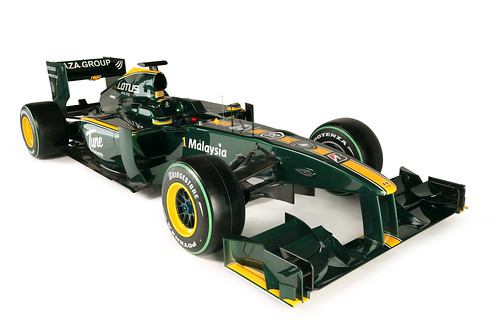
The degree to which the new Lotus F1 team is related to The Lotus F1 team is subject to opinion, but one thing is for sure: the color's right. The Lotus Racing Official Fan Site has more.

Monday, October 26, 2009

Countach vs. Stingray: Real?

Last week Carscoop posted a Japanese commercial for Gran Turismo PSP, which very convincingly shows an '88 Lambo trading paint with a '69 'Vette. There seems to be some debate about how "real" the video is, but there is no debate at all that it is awesome:


Monday, April 27, 2009

Edwards Finishes Talladega on Foot

Carl Edwards is known for the backflips he does after winning NASCAR races, but he flipped under completely different circumstances on the last lap of Sunday's Sprint Cup race at Talladega:

Carl Edwards flips on last lap at Talladega

Nudged by eventual winner Brad Keselowski, Edwards got upside-down into the catch fence along the front straight, throwing debris into the crowd and injuring eight fans. Edwards climbed out of his car and finished the race on foot.

Sunday, April 19, 2009

Jag is Back!

Largely absent from big-league racing since the demise of the Trans-Am series after the 2005 season, Jaguar is set to make a return to sports car competition later this summer. Rocketsports racing, still headed up by the venerable Paul Gentilozzi, has announced it will enter a new Jaguar XK-R in the GT2 class of the American LeMans Series mid-season in an effort to prepare for a full 2010 campaign. The Jag will join the already impressive entry list including Ferrari F430 GTs, Porsche 911 GT3 RSRs, BMW E92 M3s, a Panoz Eperante, Chevy Corvettes, a Ford GT, and a Dodge Viper, making for some of the most diverse racing anywhere in the world.

RocketSports Racing Jaguar XK-R

More information on the Rocketsports Racing Jaguar XK-R entry can be found at RocketSportsRacing.com.

Tuesday, May 20, 2008

Indy 500 Primer

92nd Indy 500 Logo

It's that time of year again: You're laying out your plans for the long weekend, and someone invites you to an "Indy 500 party." You know it'll be fun, but you also don't know an Indy car from a train car. Read on for some helpful tips and answers to frequently asked questions.

What will I be watching?
The Indy 500 is an auto race, so you'll be watching 33 cars go over 200 mph around a big circle for a few hours.

Who should I root for?
Danica Patrick is a young, attractive, American woman, which is usually enough to get almost everyone's attention. You may have seen her recently on TV or in Sports Illustrated. She drives a black and blue car, sponsored by Motorola. She stands some chance of winning and the cameras will follow her progress closely.
Helio Castroneves was on Dancing with the Stars last season and is a happy, smiling, handsome guy with a great Brazilian accent, which is usually enough for anyone not watching Danica. He drives one of two red and white cars, sponsored by Marlboro. Helio has won the race twice before and has a good chance of winning, so the cameras will follow him closely as well.
Michael Andretti, Marco Andretti, Grahm Rahal, and A.J. Foyt IV are all the kids of famous racecar drivers from 20 - 30 years ago that you or your Dad may have heard of. Michael Andretti is Marco Andretti's dad, and looks like he's about 50 because he's about 50. The Andrettis always have a decent chance of winning, although if Rahal and Foyt even come close the TV cameras will pay them very close attention.

Is this like NASCAR?
Yes, it is a lot like NASCAR, except with very different-looking cars. NASCAR cars look like boxes, Indy cars look a little like weird airplanes with wheels. Those wheels are out there on the corners of the cars and aren't covered by anything. For this reason, this kind of racing is called "open-wheel." NASCAR is not open-wheel, but some other racing is.

Didn't Danica Patrick win Indy a few weeks ago?
No. Danica Patrick has not "won Indy" ever, including a few weeks ago. The word "Indy" comes from the word Indianapolis, the city in Indiana. "Indy" is used to describe a few different things:


The Racetrack - "Indy"
There is a racetrack in Indianapolis, IN. It opened in 1909, and is an oval shape that is 2.5 miles around. For more information, check out the track's website.
The Race - "The Indy 500"
The race on Sunday is a 500-mile race held at Indy and therefore called the Indy 500. This year will be the 92nd running of the race, which makes it one of the longest-running races in the world. For more on that history, check out the race's website.
The Series - "The Indy Racing League" or "The IRL"
A group of drivers and their cars travel around the world together to race at different tracks a few times per month. The drivers get points depending on how well they do, and at the end of the year a champion is crowned. The Indy 500 is the most famous and most prominent race in the series, and so the series is named after that race. NASCAR fans should think of the IRL like the Sprint Cup Series. Stick-and-ball sports fans should think of the IRL like MLB or NFL, but with "drivers" instead of "teams," and with only one "game" going on every weekend. You may hear someone mention that a particular driver is part of a particular team, but the "teams" in the IRL are completely different from the "teams" in MLB or the NFL. More on that later.
The Cars - "Indy Cars"
Like NASCAR, all of the drivers in the IRL use similar cars, called "Indy Cars." They are open-wheel cars with prominent wings on them, and they all use 3.5 liter V8 engines made by Honda which are not turbocharged.
The Races - "The Indy Japan 300" or "The Iowa Corn Indy 250"
Most races in the IRL have "Indy" in their name, even when they do not take place at Indy. This is simply to tie the name of the race to the series. Formula 1 fans can relate this to the inclusion of "Grand Prix" or "GP" in the names of their races.
So, Danica Patrick is a driver in the Indy Racing League, and she drove her Indy Car in the Indy Japan 300 a few weeks ago. She won that race, the Indy Japan 300, which takes place in Motegi, Japan. She has not yet won "Indy," or the Indy 500, which takes place in Indianapolis, IN, this coming Sunday.

The race is 500 miles? How long will that take?
Indy cars can go more than 230 mph under the right circumstances. The speeds during the Indy 500 will be closer to 220 mph for most of the race. If there is an accident, the rules say that all of the cars have to slow down to about 60 mph until the accident is cleaned up, which usually takes 5 - 10 minutes. Overall, the race will probably last about 3 hours.

Accidents? Do people get hurt or die?
The cars, and the race itself, is actually very safe. If there is an accident, the cars involved will stay on or very near the track, and there are lots of walls and fences to keep them away from the crowds, crews, TV cameras, etc. The walls around the outside of the track are metal guardrails attached to foam blocks, so while they are not squishy, they are not rock-hard either. The cars themselves are designed to basically explode into lots of pieces, except for the parts right around the driver. Think of those exploding pieces like a big crumple-zone. Drivers can get hurt, but usually the most serious injury is a sprain or bruise.

Can drivers keep racing even after they've been in an accident?
They can, but they usually don't. Indy Cars are fragile, and all of the parts are critical. NASCAR fans might expect to see sledgehammers and duct-tape come out after a crash, but usually if a piece on an Indy Car breaks, it takes literally all week to fix.

Someone just said "teams"
When the drivers and cars are on the track, they are all racing against each other. Race cars are expensive, and it turns out that there are only a few people with the money and interest to pay for them. Because of this, those people usually pay for more than one. All of the cars and drivers that get paid for by the same person are on a "team." Some of the "teams" have only one car and one driver, but some "teams" have several. Usually, all of the cars and drivers who are on the same team go back to the same research facility between the races, so if someone figures out how to make one of the cars a little faster, the other drivers and cars on that same team will probably hear about it first. Also, a driver is less likely to act like a jerk on the track towards another car on the same team. You will probably hear about how many cars and drivers each team has, how many times each team has won the race, and how "teammates" are helping each other out on the track. As much as you will hear those things, at the end of the race, every driver is racing every other driver.

Will this be fun?
Yes, it will probably be fun. Even beyond the fun people and good food you're likely to be surrounded by, the race itself is very exciting. The cars are going very fast, and they are very close to each other. Driving the cars is difficult, and it is exciting to watch the drivers try not to make any mistakes at all for three whole hours.

And maybe you'll get to see Danica actually "win Indy."

Sunday, March 16, 2008

12 Hours of Sebring

12 Hours of Sebring
The 56th running of the 12 Hours of Sebring has been run. A previous Street Level entry covered particular things to watch for. Here's how they turned out:

Peugeot vs. Audi
As predicted, the diesels had problems with reliability. although admittedly almost none of the issues were engine related. A hydraulic pump failure eventually ensured that the lone Peugeot would trail the Audis across the line. The Peugeot's fastest lap was quicker than the fastest Audi lap, so the 24 hour French classic in June should be a close fight.

Porsche RS Spyders vs. Audi, Peugeot
Also as predicted, the Porsche RS Spyders were just as fast as the Audis and the Peugeot despite being in the "slower" LMP2 class. Few people were surprised by Porsche's overall victory, although just as few predicted the podium sweep of LMP2 cars. An Acura squeezed its way between the first- and third-place Porsches, relegating the lead Audi to fourth.

Risi Competizione vs. Flying Lizard Motorsports
The Risi Ferrari was poised to take a second-straight Sebring victory until about the halfway point of the race. Jamie Melo, the driver who took the Ferrari across the line at the incredible end of last year's race, got into the grass on the inside of turn 7, then came across the track into the front corner of Dirk Werner's Porsche. Both cars limped through the grass in an attempt to get back to the pits, but both cars ended up parked in the grass. Jörg Bergmeister and Flying Lizard Motorsports took full advantage and the class victory.

Chevy vs. Ford vs. Dodge
This classic battle played out roughly as expected. The LG Corvette seemed to have the edge and posted the fastest lap time of the three, however it succumbed to overheating problems after less than 100 laps. The Viper then pulled from the Ford, which planted itself into a wall about 100 laps after the Corvette's exit. All three are expected to improve over the course of the season, so look for this battle to heat up.

The final class victors of the 2008 12 Hours of Sebring were:

LMP2: Romain Dumas - Porsche RS Spyder - Penske Racing
LMP1: Tom Kristensen - Audi R10 - Audi Sport North America
GT1: Johnny O'Connell - Corvette C6.R - Corvette Racing
GT2: Marc Lieb - Porsche 911 GT3 RSR - Flying Lizard Motorsports

Saturday, March 15, 2008

Formula 1 - What To Watch For

Formula 1
Early Sunday morning will mark the start of the 2008 Formula 1 season. After an incredibly exciting championship battle last season which saw Kimi Raikonnen edge out both McLaren-Mercedes drivers in the last race to win the season, several changes to the rules and teams should keep this season entertaining. Here's what to watch for:

Traction Control
For the past few years, drivers have employed the use of electronic traction control to get their cars off of the line and out of the corners. Starting this season, traction control of any kind is banned, and should add quite a bit of spice to the races. Drivers who have previously just powered out of corners or through difficult sections will have to carefully modulate the throttles on their cars or lose control of the back end. Watch closely during wet races or on tracks with limited grip, like the season-opening Australian GP.

Fernando Alonso
After winning two consecutive world championships, Fernando Alonso left Renault for McLaren-Mercedes, where he placed third in 2007 and had a much-publicized feud with his rookie teammate. This season, Alonso is back at Renault where he is apparently much more comfortable. Unfortunately, Renault has lost their way and did not regularly compete for podiums in 2007. Watch for Alonso to try to right this listing ship in spectacular style.

Lewis Hamilton
Hamilton put together a sensational rookie season in 2007, very nearly becoming the first ever rookie world champion. Now the darling child of McLaren-Mercedes, look for him to try to prove that his success was not a fluke.

Sebastien Bourdais
Winning four consecutive Champ Car World Series championships finally scored Bourdais a Formula 1 ride. Driving for Scuderia Toro Rosso, Red Bull Racing's "little brother," Bourdais brings plenty of talent and open-wheel experience to the table. STR has had trouble scoring points, let alone fighting for podiums, so Bourdais will certainly have his work cut out for him. Ex-F1 backmarker Robert Doornbos had a moderate amount of success in Champ Car (winning Rookie of the Year in 2007), so few are expecting Bourdais to catapult STR to the front of the field. Like him or not, Bourdais is essentially representing the full might of American open-wheel racing, however ailing it might be, so it will be interesting to see how much success he finds in open-wheel's top tier series.

Friday, March 14, 2008

2008 12 Hours of Sebring - What To Watch For

12 Hours of Sebring Logo

The 56th running of the 12 Hours of Sebring begins Saturday, March 15th, at 10am. The race is almost always exciting and this year should be no exception. Here are a few specific things to watch for this weekend:

Peugeot vs. Audi
Last year, Audi stood alone in the (competitive) diesel camp, but will be joined this year by one of the diesel Peugeot 908s that ran at LeMans last year. While the 908s couldn't stay with the Audis last June, the practice times in Florida have been incredibly close. Reliability will be a factor here, as the close competition will push the still-relatively-new engine technology to its limit.

Porsche RS Spyders vs. Audi, Peugeot
Last season, the Porsche RS Spyders of Penske Racing were constant threats for overall wins, scoring several over the theoretically-faster Audis. Look for them to continue to pressure the bigger, more powerful LMP1 cars. Audi is going for its ninth-straight win at Sebring, and may get as much trouble from Porsche as from Peugeot.

Risi Competizione vs. Flying Lizard Motorsports
Last year, Jamie Melo in the Risi Competizione Ferrari 430 beat Jorg Bergmeister in the Flying Lizard Motorsports Porsche 911 by a scant .2 seconds in what was one of the most exciting finishes in the race's long history. The Risi Ferrari ultimately took the championship as well, but look for Flying Lizard to try to take back what they feel was stolen from them last March.

Chevy vs. Ford vs. Dodge
For the first time in ALMS competition, Chevy, Ford, and Dodge will all be represented in one class on Saturday. Operating outside the factory-backed GT1 effort, three-time Speed World Challenge champions LG Racing are bringing their Corvettes to Sebring to compete in the GT2 class. Robertson Racing has brought a Ford GT-R to the party (one of the first to compete in the U.S.), reminding us of the mid 60's when Ford developed the original GT40 specifically to beat Ferrari on the racetrack. Also unrelated to past GT1 efforts is Primetime Racing's Viper Competition Coupe, which ran in a few events last season in preparation for a full 2008 campaign. All three of these efforts are without factory backing or extensive ALMS experience, so none are considered significant contenders for a class win, however the fight to be the Fastest of the Slowest should be entertaining.

While we can only hope for a finish as riveting as last year's GT2 battle, the 56th running of the 12 Hours of Sebring is almost certainly going to be one of the best races of the season.

Wednesday, February 27, 2008

Open Wheel Racing Merger Details

Indy Car Series Logo

Today's IRL press conference provided the official details of the "merger" between the Indy Racing League and the Champ Car World Series:
  • The "new" series will keep the name Indy Racing League
  • Teams will use the IRL's Dallara-Hondas.
  • The season will start with a race at the Homestead-Miami Speedway on March 29
  • The Long Beach Grand Prix and the Indy Japan 300 will both be run on April 20.
    • Old Champ Car teams that are making the switch to the IRL will contest the Long Beach GP for IRL points and prize money using their equipment from the 2007 season
  • All events scheduled to be on the 2008 Champ Car calendar are under consideration for possible integration into the 2009 IRL calendar, and in fact as many as possible will be integrated into the 2008 season
    • Long Beach is confirmed to have a place on the 2009 calendar
  • Champ Car teams that can commit to the full 2008 season are receiving $1.2 million, plus leased cars and engines to aid in the transition

Tuesday, February 19, 2008

American Open-Wheel Split Over

Indy Car World Series Logo

Finally.

The persistent dream of any fan of either the Champ Car World Series or the Indy Racing League has finally arrived: The two series are set to merge in time for the start of the 2008 racing season.

For 11 years the series have been separate entities, fighting for teams, sponsors, and fans. Originally a matter of ovals vs. road courses, each series diluted itself to become all things to all people, with neither accomplishing the desired result.

Robin Miller's article at SpeedTV.com has all of the currently-available details, but the important points follow:
  • Tony George, founder and current leader of the IRL, has offered free cars and $1.2 million to any Champ Car team that wishes to defect and is able to commit to the entire season.
  • Four current Champ Car teams have committed to the switch, with at least one more probable, bringing at least eight cars to the current IRL lineup.
  • The IRL is planning to integrate four current Champ Car race locations and dates into the 2008 calendar, including the Long Beach GP scheduled for April 20.
The result isn't so much a merger as Champ Car finally going under and the IRL salvaging the larger pieces. Few people, even die-hard fans of Champ Car, would argue that even this result is significantly better than two independent series. With any luck, the combination of the best open-wheel drivers, teams, and venues will attract long-lost fans and sponsors and return North American open-wheel racing to the top shelf.

--Update--
The deal is officially done, per Robin Miller's follow-up article.

Wednesday, November 07, 2007

Kimi Raikonnen Breaks Through with Style

Kimi Raikonnen
For only the eleventh time in F1 history, the World Championship was contested by three drivers coming to the last round in Brazil. Only once before, in the first year of Formula One, did the third place driver overcome the long odds to take home the championship, but that is exactly what happened this past weekend.

Kimi Raikonnen lived up to his nickname of "Iceman" throughout the duration of the Brazilian GP, despite the championship resting not only on his victory, but on luck as well. Even if Kimi won the race, points leader Lewis Hamilton would have to finish worse than 5th to give the Raikonnen the title, and fans of F1 know that luck is something the Finn has never had much of on the track.

Against all odds, Raikonnen won the race and Hamilton suffered both navigational and mechanical difficulty, and finished just far enough back for Kimi to take the championship.

Sunday, June 17, 2007

2007 24 Hours of Le Mans - Finish

2007 24 Hours of Le Mans 9:00 am Sunday
After 369 laps (3125 miles), the 2007 24 Hours of Le Mans has concluded. The class winners are:
LMP 1: #1 Audi Sport North America Audi R10 (Biela, Pirro, Werner)
LMP2: #31 Binnie Motorsports Lola Zytek B05 - 40 (Binnie, Timpany, Buncombe)
LMGT1: #009 Aston Martin Racing Aston Martin DBR9 (Brabham, Rydell, Turner)
LMGT2: #76 IMSA Performance Porsche 911 GT3 RSR (Narac, Lietz, Long)

For a complete listing, please see the official website of the 2007 24 Hours of Le Mans.

2007 24 Hours of Le Mans - "Live" Coverage
Section 3

Flying Lizard Motorsports 8:19 pm (ET) Saturday
Coming back from the latest break in Speed Channel coverage, we learn that the #80 Flying Lizard Motorsports Porsche 911 has been retired due to a cracked crankcase. Unfortunately this prevents any kind of final-hour battle between Jorg Bergmeister and Jamie Melo such as at the 12 Hours of Sebring.

9:14 pm Saturday
We have had a chance to get up-close footage of several Peugeot pitstops, and during all of the recent stops, mechanics have pulled louvers off of the sidepods of the car to pull rubber bits out of the radiators located there. We have just learned that the 908s are in fact having cooling problems, even in the cool night air. When Audi first introduced the R10 and ran at Sebring, they experienced similar problems and attempted similar mid-race solutions. Both teams have gone to their most open louver patterns at the expense of a small amount of added drag. Audi eventually reconfigured the cooling system of the car after that Sebring race, so Peugeot may have trouble rectifying the problem while still here at Le Mans.

9:35 pm Saturday
During an interview in the Team Oreca pits, Steve Saleen has revealed that he has stepped down from his leadership position at Saleen, Inc. According to Saleen, he is "there in spirit" and "still supporting the company," however he is directing his efforts at a company aiming to import Chinese cars to the American market. This is no doubt somewhat disappointing to fans of the Saleen S7, and leaves one to wonder what is in the water that would cause the likes of Malcom Bricklin and Steve Saleen to busy themselves with these ventures.

9:52 pm Saturday
The #82 Team LNT Panoz Esperante has been wheeled into the garage, likely for extensive repairs. The #81 sister car retired some time ago, continuing the lackluster performance of Panoz cars at Le Mans. With the exception of the unlikely GT2 win last year, the Panoz cars have been relatively unsuccessful. This is somewhat surprising considering Dr. Don Panoz started the American Le Mans Series himself.

10:38 pm Saturday
The #55 Oreca Saleen S7R has been wheeled back into the garage with starter trouble. This was the leading Saleen and was running 6th in class when it came in.

12:00 am Sunday
An interview with Team LNT owner/driver Richard Dean revealed that the #82 Panoz Esperante suffered a suspension upright failure, necessitating a lengthy repair and dimming the hopes of a repeat class victory. The sister #81 Panoz, the only other Panoz in the field, retired from the race after less than 70 laps.
Also out of the race are both Spyker C8 Spyders.

Risi Competizione 12:20 am Sunday
The class-leading Ferrari F430 of Risi Competizione has been wheeled into the garage with front radiator damage. The cause of the damage is unclear, although it is severe enough to warrant a radiator change. This will certainly take a number of laps, putting the Ferrari's previously-dominant lead in jeopardy.

12:55 am Sunday
Prodrive Aston Martin has suffered a slight setback with the #007 DBR9. It has apparently taken an off-course excursion and damaged the front splitter to the point of needing replacement. The car is currently in the garage although it appears to be a quick fix.

1:35 am Sunday
The race leading #2 Audi R10 has been pitched into a tire barrier; replays show one of the wheels coming off of the car prior to the incident. Rinaldo Capello has left the car and it appears as though his day is done.

5:45 am Sunday
The Risi Competizione #97 Ferrari has been retired from the race, presumably due to complications with the radiator damage sustained earlier. The sister #99 car is still running, and is in fact second in class.

6:39 am Sunday
Peugeot's lead entry has been wheeled into the garage where the engine cover came off in a hurry. Two mechanics are thoughtfully holding the engine cover in front of the garage door, completely blocking any camera shot. This is possibly an evolution of the cooling problems that have plagued the two French entries throughout the race.

6:52 am Sunday
An interview with Giuseppe Risi has revealed that the radiator damage on the #99 Ferrari F430 caused irreparable water pump damage that then retired the car.

7:22 am Sunday
The #7 Peugeot has been brought out of the garage and back to the track. The exact issue is still unknown, although it is strongly suspected to be electrical. The car then stalled twice on leaving the pits, although it isn't known if the stalls are related to the other problem. Unfortunately the car has spent enough time in the garage that a podium finish is incredibly unlikely.

Peugeot Sport 7:37 am Sunday
The ailments to the #7 Peugeot have proven terminal, as the car has been officially retired from the race.

8:14 am Sunday
The safety cars have been deployed due to the torrential rain that has been pounding the track for the last hour or so. This is bad news for the remaining Corvette Racing C6R, as it had been running significantly quicker than the leading Aston Martin DBR9 in the rain. The Vette is still one lap back of the Aston, so it will not be able to pass while under the safety car. Corvette Racing is obviously opposed to the safety car deployment; their arguement is that no cars had yet gone off of the track due to the rain.
The remaining Peugeot has just come in for what looked to be a routine pit stop for a final splash of gas, but it was immediately put up on dollys and wheeled into the garage when it came in.

8:20 am Sunday
It has been reported that during a previous interview with Oliver Gavin, he indicated that the reason for the prop shaft failure that put the #64 Corvette Racing C6R out of the race was caused by a harmonic vibration which occured when two of the engine's cylinders were shut down as a fuel-saving measure during a safety car period.

8:49 am Sunday
With just over ten minutes left in the race, the safety cars have been parked and the racers let loose. The strongest implication is in the GT1 class, where Ron Fellows now has a chance, however slight, of catching David Brabham in the lead Aston Martin DBR9.

Saturday, June 16, 2007

2007 24 Hours of Le Mans - "Live" Coverage
Section 2

Corvette Racing C6R
5:35 pm (ET) Saturday
An interview with Oliver Gavin revealed the reason for the "disqualification" of his Corvette Racing C6R: a regulation stating that the cars must move along the track under the power of their drive motors. It was not the aid he received that dropped him from the race, but the fact that he could not repair the damage to the drivetrain.
The previously-wrecked Audi R10 has also withdrawn from the race, no doubt due to damage sustained in the massive-looking crash earlier.

5:57 pm Saturday
The #2 Audi R10 has just come in from the lead for a pit stop. Rinaldo Capello has remained in the car for what will be his third stint, which is not itself unusual. What is interesting is that the Audi crew put a fresh set of tires on the R10 before sending it out. Since driver changes normally only occur during stops including tire changes, the implication is that Capello will stay out for another stint past this one, for a total of four straight, which is two more than normally expected.

6:37 pm Saturday
Flying Lizard Motorsports has been getting a fair amount of attention this weekend for their paint scheme performed by Troy Lee Designs. This Spring at the 12 Hours of Sebring, the Flying Lizard Porsche 911 put up a last-lap fight with the Risi Competizione Ferrari 430. Unfortunately, it looks like the #80 911 will struggle to fight with the Ferrari again, as it is currently in the garage sporting a large oil slick along the left rear of the car.
It has been reported that earlier in the race, the passenger door actually blew off of the car, heavily damaging the rear wing as it came off. The current problem is apparently due to a gearbox issue that they have been struggling with for most of the day.

2007 24 Hours of Le Mans - "Live" Updates

24 Hours of Le Mans8:20 am (ET) Saturday - Pre Race
The 75th running of the 24 Hours of Le Mans is less than an hour from going green.
The rain-complicated qualifying produced some unexpected results:
The previously-dominant Audi R10s find themselves behind the new Peugot entry. Both cars run on diesel fuel, and between the two models they take up the top five starting grid positions. Similarly, the Corvette Racing C6Rs will have to work past not only an Aston Martin, but also a Saleen S7R. Saleens have previously raced at Le Mans, but the two racing today are fielded by Team Oreca, made famous by their domination of this race and the series with their Chrysler Vipers ten years ago. Over the course of 24 hours, a starting advantage of a few carlengths will certainly shake itself out, but it will make for some entertaining racing early.
Rain is in the forecast for the race, which will continue to make things interesting. While rain rarely stands in the way of an ALMS race, the teams are no doubt much more practiced on dry pavement than on wet. It has been a few years since rain was a factor at Le Mans, and should add to the already huge levels of excitement, particularly since the track is more than 8 miles long, and weather conditions at one end can have no resemblance to those at the other.

9:02 am Saturday - Race Start
Champ Car World Series superstar Sebastien Bourdais overcooked the first set of corners after starting on the pole, and while he made an incredible save to keep the car going on the track he has given up the lead to the #2 Audi R10.

9:38 am Saturday - First Pit Stops
As the race leaders come in for their first pit stops, we're reminded that the ACO has retained their regulations regarding wheelspin leaving the pits. Any car spinning its wheels while leaving the pits will be held for a three minute penalty, translating to nearly a lap. Anyone watching pit stops in virtually any American racing series will find it hard to even imagine a pit stop that didn't end in billowing smoke and a healthy fishtail from the exiting car.
In order to comply with this regulation, the launch control of the cars has been specially tuned. This could remain an issue for the lead cars, however, as all five diesel entries produce enormous amounts of torque at very low engine speeds.

9:50 am Saturday
After the first round of pit stops for the leading cars, the three Audi R10s have taken the top three spots, regulating the two Peugeots to fourth and fifth, and the top running Pescarolo to sixth.

10:07 am Saturday
The safety cars have been deployed and while the exact reasons for that have not been discovered yet, the #21 Radical SR9 has just come to the pits missing the rear wing entirely and with extensive damage to both the front and rear bodywork.

10:35 am Saturday
The #3 Audi R10 driven by Mike Rockenfeller has crashed heavily on the corner leading to the Mulsanne straight. Video replays are currently unavailable, but still shots of the damage to the guardrail reveal extensive damage. The rear wing of the R10 appears to be lodged in the guardrail, so a rearward collision is likely. The condition of Rockenfeller is currently unknown, although there are reports that the Audi team managers are not only in radio contact with Rockenfeller, but are considering the possibility of driving the car back to the pits. This seems an unlikely possibility, although the Audis are legendary in their stout construction.

10:44 am Saturday
During the safety car period caused by the above Audi crash, the #64 Corvette Racing C6R has stopped on the course with apparent gearbox issues. According to program manager Doug Fehan, the problem is likely a broken driveshaft, which would certainly leave driver Oliver Gavin unable to move under his own power and therefore out of the race.

10:49 am Saturday
The #64 Corvette's problems were apparently gearbox related. After being pushed off of the circut by the stewards, Oliver Gavin was able to find a gear and began to pull back onto the track. Unfortunately for Corvette Racing, since the stewards had provided assistance, he was apparently immediately disqualified from the race and not allowed to continue.

11:00 am Saturday
Going into the first break in SpeedTVs coverage, Oliver Gavin is still trackside with his ailing C6R. The problem has been traced to the prop shaft coming from the engine and going into the transmission. While the Vette's powerful motor can't spin the transmission, the movement seen ten minutes ago was apparently due to Gavin engaging a gear and running the starter motor.
Although able to move the car, it appears that Gavin is still out of the race after receiving help from the stewards. Program manager Doug Fehan will certainly do everything he can to keep the car in the race, although the odds of that seem long at this point.

Monday, April 02, 2007

12 Hours of Sebring Decided by .2 Seconds

Mobil 1 12 Hours of SebringThe 12 hours of Sebring is the first event in the 2007 American LeMans Series calendar, and is a mainstay of American road racing. Huge names, from Andretti to Foyt to Rahal, have been victorious at the legendary Floridian airport course.
The 2007 field was criticized for thin P1 and GT1 competition, but the P2 and GT2 classes were robust and the action was intense. The 12 hour race had many highlights, including a dramatic Ferrari engine fire, but the grand finale was the GT2 class finish.
Jamie Melo in the Risi Competizione Ferrari 430 had been holding off Jorg Bergmeister in the Flying Lizard Motorsports Porsche 911 for hours, but with only a few minutes to go the 911 had fresh tires and a fresh driver to take on the weary Melo and his worn rubber. The two crossed the finish line just ahead of the lead Audi R10 with only half a second between them, the Ferrari leading the charging Porsche. As the Audi crossed the line to take the overall victory, the two most successful marques in Sebring history were set to to do battle for one of the most exciting laps in recent memory. The following video shows the dramatic fight that carried on literally right to the finish line.